
Top Pallet Racking Systems Compared: Which One Fits Your Needs?
In today’s fast-paced supply chain, the right storage strategy can make or break efficiency. Whether you’re running a small warehouse or a large distribution center, choosing the best pallet racking systems is essential for maximizing space, improving safety, and streamlining operations.
But with so many types available, how do you know which system fits your needs? This guide compares the most popular pallet racking solutions, breaking down their features, advantages, and ideal use cases.
Why Pallet Racking Systems Matter
Warehouses face constant pressure to store more while maintaining accessibility. Pallet racking systems solve this by:
- Making full use of vertical space.
- Improving inventory management and order picking.
- Supporting heavy loads safely.
- Allowing flexible layouts that grow with your business.
Without an efficient racking system, warehouses risk clutter, slower operations, and higher safety risks.
The Most Popular Pallet Racking Systems
- Selective Pallet Racking
- Overview: The most widely used system worldwide. Each pallet has a dedicated slot, making it easy to access any item without moving others.
- Pros:
- Affordable and simple to install.
- High accessibility—ideal for warehouses with diverse SKUs.
- Compatible with most forklifts.
- Cons:
- Lower storage density compared to other systems.
- Best For: Businesses needing quick access to a wide range of products.
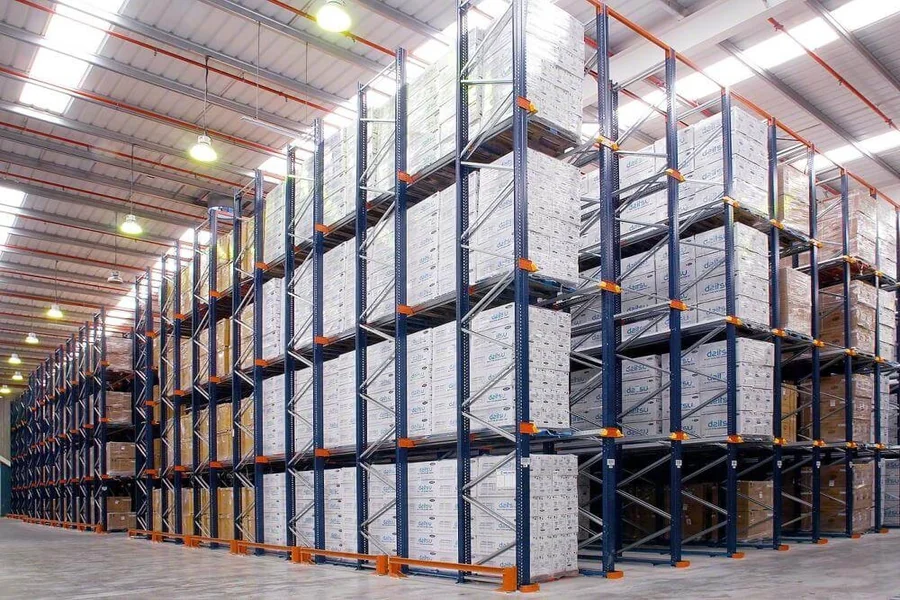
- Drive-In and Drive-Through Racking
- Overview: Forklifts drive directly into the system to load and retrieve pallets. “Drive-In” supports Last-In-First-Out (LIFO), while “Drive-Through” supports First-In-First-Out (FIFO).
- Pros:
- High-density storage for bulk goods.
- Maximizes floor space.
- Cons:
- Limited selectivity (not ideal for many SKUs).
- Requires careful forklift handling.
- Best For: Cold storage, food, and beverage industries storing large volumes of similar items.
- Push-Back Racking
- Overview: Pallets are stored on carts that slide backward on inclined rails. As one pallet is removed, the next one rolls forward.
- Pros:
- Greater storage density than selective racks.
- Quick loading and unloading.
- Cons:
- Higher upfront cost.
- Limited to 2–6 pallets deep per lane.
- Best For: Warehouses with medium-turnover inventory and limited space.
- Pallet Flow (Gravity Flow) Racking
- Overview: Pallets are loaded at one end and move forward on gravity rollers, ensuring FIFO rotation.
- Pros:
- Excellent for inventory with expiration dates.
- Saves labor with automatic flow.
- Cons:
- Higher installation costs.
- Requires precise design for smooth operation.
- Best For: Food, pharmaceuticals, and perishable goods.
- Cantilever Racking
- Overview: Built with arms extending from vertical columns, ideal for storing long or irregular-shaped items.
- Pros:
- Perfect for lumber, steel, or pipes.
- Flexible design for oversized goods.
- Cons:
- Not suitable for palletized products.
- Best For: Construction and manufacturing businesses.
- Double-Deep Racking
- Overview: Pallets are stored two deep, requiring forklifts with extended reach.
- Pros:
- Higher storage density than selective racks.
- Cost-effective compared to push-back systems.
- Cons:
- Reduced selectivity.
- Specialized equipment needed.
- Best For: Businesses balancing selectivity and storage density.
Key Factors When Choosing a System
Before deciding, consider these factors:
- Inventory Type: Perishables need FIFO (pallet flow), while bulk goods may work with drive-in systems.
- Space Availability: Smaller warehouses may benefit from push-back or double-deep.
- Forklift Access: Some systems require specialized equipment.
- Budget: Initial costs vary—selective is cheapest, while flow systems are more expensive but efficient.
- Scalability: Choose a system that can grow with your business needs.
Final Thoughts
Choosing the right pallet racks systems is about more than storage—it’s about efficiency, safety, and scalability. From affordable selective racks to high-density pallet flow systems, there’s a solution for every business model.
Take time to evaluate your inventory, space, and budget, then match them to the system that best fits your needs. The right decision today ensures smoother operations, safer warehouses, and stronger long-term growth.
FAQs
Q: What’s the cheapest pallet racking system?
A: Selective racking is usually the most budget-friendly option.
Q: Which pallet racking system saves the most space?
A: Drive-in/drive-through and pallet flow racks maximize storage density.
Q: Can I mix different racking systems in one warehouse?
A: Yes—many warehouses use a hybrid approach to balance accessibility and density.
Q: How long do pallet racks last?
A: With proper maintenance, racking systems can last 15–20 years or more.