
How Long Does It Take to Charge a Solar Battery?
Solar panels glistening on a rooftop promise free, clean energy – until you realize your battery still shows half charge after a full day of sunlight. The time needed to charge a solar battery depends on a delicate balance between your equipment’s capabilities and nature’s unpredictability. Unlike plugging into a wall outlet where charging times are relatively consistent, solar charging involves numerous variables that can turn what should be an 8-hour charge into a 2-day process. In this article, we’ll demystify the solar charging timeline, explain how to calculate your specific situation, and share practical tips to optimize your system’s performance.
1. Key Factors Affecting Charging Time
Battery Capacity (Ah/Wh)
Battery capacity acts like a water tank – the larger it is, the longer it takes to fill. A 100Ah (1200Wh) battery requires twice as much energy to charge as a 50Ah (600Wh) model under identical conditions. However, capacity ratings can be misleading; most batteries shouldn’t be fully discharged, so the actual usable capacity might be 20-30% less than advertised. Lithium batteries typically allow deeper discharge (80-90% of rated capacity) compared to lead-acid’s 50% limit. When calculating charging times, always consider the depth of discharge from your last use – a battery drained to 20% needs to replenish more than one at 50%.
Solar Panel Wattage
Panel wattage represents the theoretical maximum energy output under ideal laboratory conditions (1000W/m² sunlight at 25°C). A 100W panel can produce about 100Wh per peak sun hour, but real-world output averages 70-85% of rated capacity due to various inefficiencies. The key isn’t just the panel’s sticker rating but its actual performance in your environment. Two 100W panels wired in series will charge faster than a single 200W panel in cloudy conditions because higher voltage systems cope better with suboptimal light.
Sunlight Intensity & Peak Hours
Solar irradiance varies dramatically by location, season, and weather. The term “peak sun hours” refers to the equivalent number of hours per day when sunlight intensity averages 1000W/m². Desert areas might enjoy 6-7 peak hours, while cloudy regions may only get 2-3. Morning and evening light produces about 30-50% of noon output, so 8 hours of daylight doesn’t equal 8 peak hours. Atmospheric conditions matter too – hazy skies can reduce output by 20%, and panel temperatures above 25°C decrease efficiency by about 0.5% per degree.
2. Calculating Your Specific Charging Time
Simple Formula: (Battery Ah × Voltage) ÷ (Panel Watts × 0.8)
A basic charging time estimate divides the battery’s watt-hours (Ah × voltage) by the panel’s adjusted wattage (rated watts × 0.8 for inefficiencies). For example, a 12V 100Ah battery (1200Wh) with a 200W panel would theoretically charge in (1200) ÷ (200 × 0.8) = 7.5 peak hours. However, this assumes perfect conditions – reality often doubles this time. As the battery fills, absorption charging slows dramatically – the last 20% can take as long as the first 80%. Advanced lithium batteries with maximum power point tracking (MPPT) charge controllers may achieve 90-95% efficiency, while older PWM systems might only reach 70-75%.

Real-World Efficiency Factors
Multiple layers of inefficiencies accumulate in solar systems: dirty panels (up to 25% loss), suboptimal angles (5-20% loss), cable resistance (2-5% loss), charge controller losses (5-30%), and battery charging inefficiency (10-20%). A system that should charge in 5 ideal hours might realistically need 8-10 hours when accounting for these factors. Temperature plays a dual role – cold improves panel efficiency but reduces battery performance, while heat does the opposite. The best approach is to monitor your actual system over several days to establish personalized baselines rather than relying solely on theoretical calculations.
3. Ways to Reduce Charging Time
Adding More/Larger Panels
Doubling your solar panel array typically cuts charging time nearly in half, but with diminishing returns. There’s a limit to how much energy your battery can accept , so adding panels beyond this point wastes money. MPPT controllers help maximize panel output by constantly adjusting the electrical operating point, especially valuable when using multiple panels. For large systems, consider panels with higher voltage ratings to reduce energy loss over long wire runs.
Optimal Panel Positioning
Adjustable panel mounts can boost daily energy harvest by 25-50% compared to fixed installations. The ideal tilt angle equals your latitude in winter, latitude minus 15° in summer. Morning sun favors east-facing panels, while afternoon sun prefers west. Even small shadows can disproportionately reduce output – micro-inverters or power optimizers mitigate this. For portable systems, repositioning panels every 2-3 hours to follow the sun can cut charging time by 30%.
4. Different Battery Chemistry Comparison
Lithium iron phosphate (LiFePO4) batteries charge fastest, accepting up to 1C (full charge in 1 hour) with proper equipment, though most solar systems charge at 0.2-0.5C for longevity. Lead-acid batteries typically limit charge current to 0.1-0.2C, making them slower despite lower capacity. Nickel-based batteries fall between these extremes. Lithium batteries maintain high charge acceptance throughout most of the cycle, while lead-acid slows dramatically above 80% charge. However, fast charging generates heat that can degrade batteries over time – the sweet spot balances speed with battery lifespan, usually around 4-8 hours for a full charge from solar sources.
5. Seasonal & Weather Impacts
Winter presents multiple charging challenges: shorter days, lower sun angles, and potential snow cover. A system that charges in 5 hours during summer might need 15+ hours in winter. Conversely, summer heat can reduce panel output by 10-25% despite longer days. Seasonal preparation involves adjusting panel angles, ensuring clear snow paths, and possibly reducing energy consumption during low-light periods. Cloudy days might produce only 10-25% of normal output, requiring multiple days to fully charge – this is why battery capacity should cover 2-3 days of autonomy for critical systems.
Conclusion
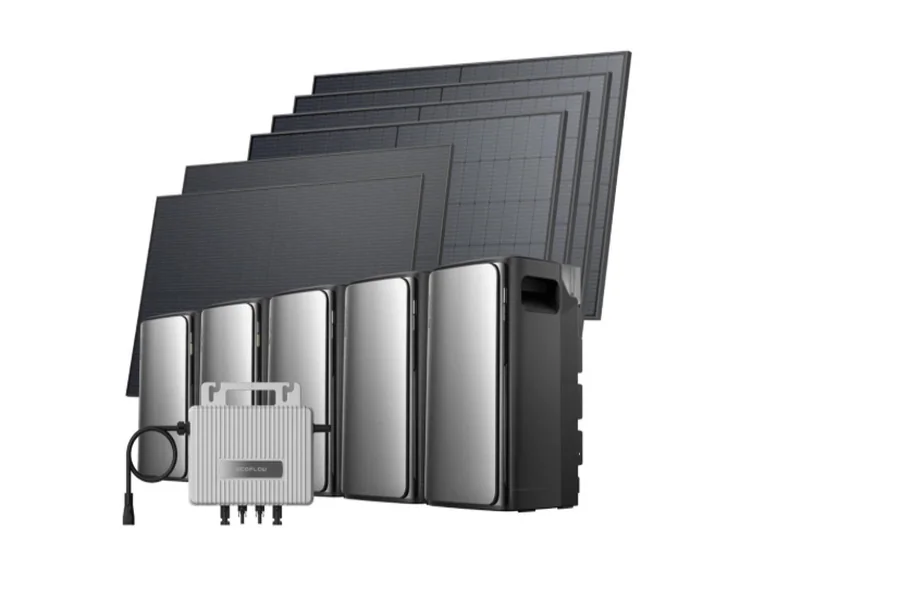
Solar charging times vary widely – a typical 100Ah battery might charge in 5 hours under ideal summer conditions or take 3 cloudy winter days. The key is matching your expectations to your specific system and environment. For those designing new systems, modular solutions like the EcoFlow Power Kit offer flexible expansion from 1.92kWh to 11.52kWh capacity with intelligent solar input management, making it easier to balance charging speed with energy needs. Remember: solar power isn’t about instant gratification but sustainable energy independence. With proper planning and reasonable expectations, your solar battery system will keep you powered through sunny days and cloudy periods alike.